Behavioral Economics · Organizational Behavior · 2026

Your organization is not failing because it lacks information. It is failing because it is structured to ignore what it already knows.
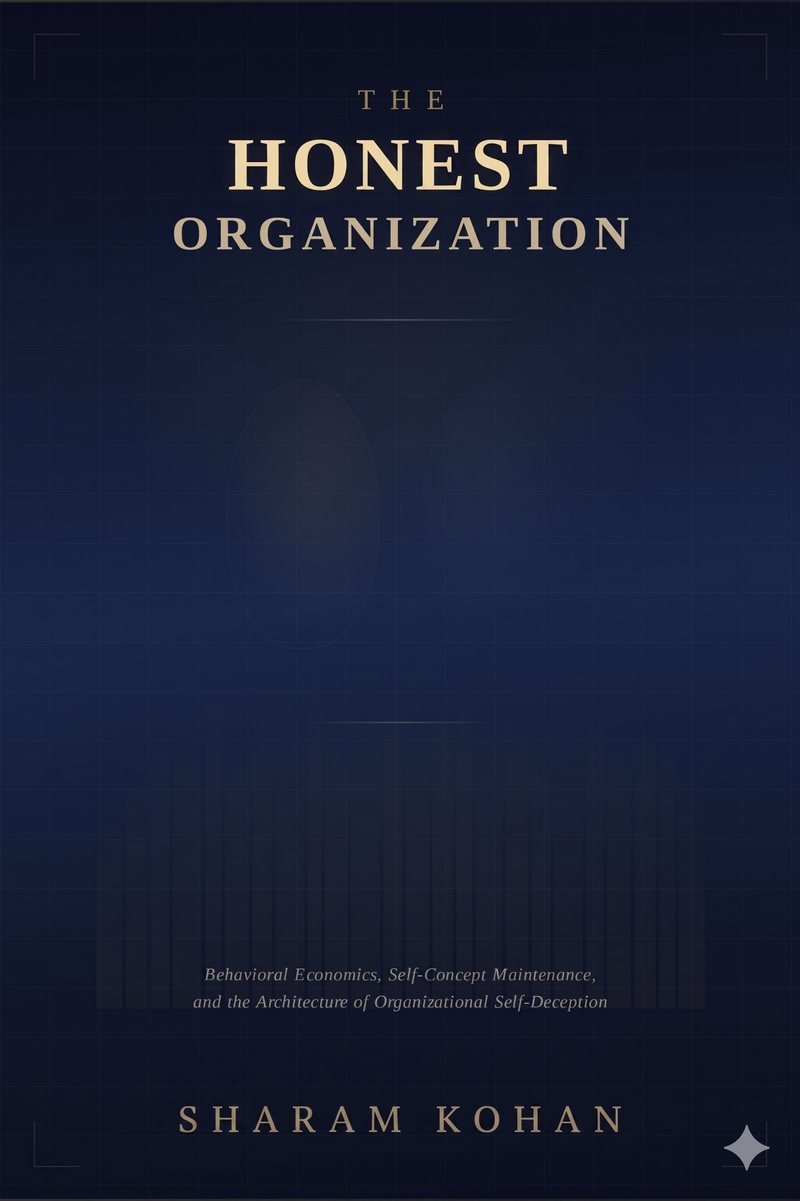
The Honest Organization by Sharam Kohan

What this book is about

You have watched a talented organization eliminate the people who told the truth, promote the people who caused the problem, and then hire a consultant to find out what went wrong. You do not need another book about leadership. You need to understand why the organization cannot stop.

The Honest Organization argues that the conventional explanation, that these organizations lack information, is wrong. They do not lack information. They lack the structural capacity to act on what they already know. This book explains the behavioral mechanisms that make that failure inevitable, and provides a structural design framework to correct it.

About the Book
9
Chapters synthesizing behavioral economics research with practitioner observation
251
Pages of analysis, case study, and structural prescription

Who this book is written for

Senior HR Leaders & CHROs
Who have inherited dysfunctional systems and require a theoretical account of why standard interventions fail.
CEOs, COOs & General Managers
Of mid-size organizations who recognize the pattern of self-defeating behavior and want a structural rather than cultural explanation.
General Counsel & In-House Attorneys
Who observe how organizational self-deception generates the legal exposure they are retained to manage.
Academics & Graduate Students
In organizational behavior, management, and applied behavioral economics who want practitioner grounding for their research.
Executive Coaches & Consultants
Who seek a rigorous theoretical foundation for the resistance-to-change phenomena they observe in client organizations.
Board Members & Governance Professionals
Who are positioned to authorize structural changes but require a clear account of what they are authorizing and why.
Business School Faculty & MBA Programs
Seeking a practitioner-grounded text that bridges behavioral economics theory and applied organizational analysis.
Anyone Who Has Watched an Organization Self-Destruct
Despite clear warning signs, and who needs a rigorous explanation, not reassurance.

What you will find inside

Introduces the diagnostic gap between available information and organizational response. Establishes the six domains where organizational rationality fails most consequentially.
Constructs the full theoretical framework: self-concept maintenance, prospect theory, motivated reasoning, and escalation of commitment.
Reframes the Peter Principle through behavioral economics. Introduces the Incompetence Ratchet.
A detailed case study showing all four mechanisms operating simultaneously in a real organizational crisis.
Examines how organizations label complainants to dismiss diagnostic signals.
Argues that culture is an emergent property of self-concept maintenance episodes, not an independent cause.
Reframes low morale as a symptom of organizational self-deception.
Maps each behavioral mechanism to specific legal liability.
Presents five design principles and a practitioner's implementation roadmap.
See the full chapter breakdown

The four mechanisms

Self-Concept Maintenance
The cognitive and motivational processes by which individuals and organizations filter, reframe, and suppress diagnostic signals that threaten a settled self-image.
Loss Aversion & Prospect Theory
The psychological cost of admitting a past error consistently outweighs the expected benefit of correction, making self-correction structurally improbable.
Motivated Reasoning
Organizations do not first reason and then decide; they decide and then reason. Motivated reasoning supplies the justification after the fact, experienced as genuine analysis.
Escalation of Commitment
Time and sunk cost make organizational self-deception progressively harder to reverse. The very history that should prompt correction becomes the reason to persist.
Explore the Full Framework
Sharam Kohan, author of The Honest Organization

Sharam Kohan

Sharam Kohan has spent more than twenty-five years inside the organizational machinery this book describes, not as a theorist, but as a principal actor who has built institutions, led them through crisis, and observed, at close range, the behavioral dynamics the book identifies and names.

He studied at Harvard University, where his work centered on leadership, institutional change, decentralized authority, and the management of people. He studied law at Temple University Beasley School of Law, concentrating in employment law and employment discrimination, and he is an alumnus of the University of California, Berkeley, School of Law, where he also earned a certificate in business law. He has held executive and human resources leadership positions across healthcare, technology, manufacturing, hospitality, retail, and the nonprofit sector. His full biography sets out how that record produced the argument of this book.

Full Biography
The Honest Organization

The Honest Organization

Available as an e-book on Amazon. Published by Doxprint LLC, 2026. ISBN 979-8-234-02650-7.

Order on Amazon